

This article has been machine-translated from Chinese. The translation may contain inaccuracies or awkward phrasing. If in doubt, please refer to the original Chinese version.
Source code repository: CompilePrincipleLearning/experiment_1 · yusixian/CompilePrincipleLearning (github.com)
I. Experiment Objective
- Gain deep understanding of finite automata and their applications
- Master the method of constructing finite automata that recognize language tokens based on lexical rules
- Fundamentally master the development method for lexical analysis programs
- Be able to design lexical scanner programs that perform lexical analysis on source programs and output token sequences
II. Experiment Content and Requirements
Write a lexical analysis program that recognizes tokens.
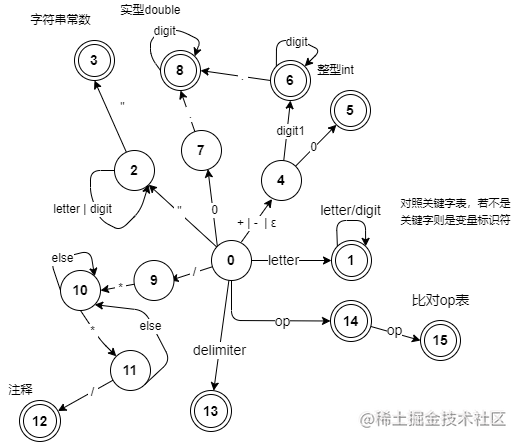
Given the DFA for each token type in a certain language as shown in the figure below, implement a program that:
-
Input: txt file (containing the source program to be analyzed)
-
Output: From the input source program, identify each independently meaningful token, i.e., five categories: reserved words, identifiers, constants, operators, and delimiters. Output the category code and the token value for each token in sequence. (Display “Error” when an error is encountered, then skip the error and continue displaying.)
Output format: Each token representation: (category code, token value)
Requirement: Each token should be output on a separate line.
The source program must contain tokens from every category.
III. Experiment Process
1. Designed DFA Transition Diagram
Letters and underscore: letter -> A|B|...|Z|a|b|c|d...|y|z|_
Digits: digit1 -> 1~9 digit-> 0~9
Identifier definition: id -> letter(letter|digit)*
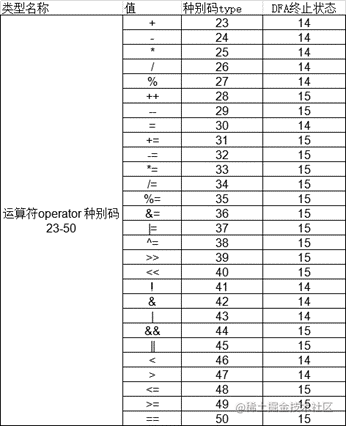
Operator definition: op -> +-*/%=!&|<>
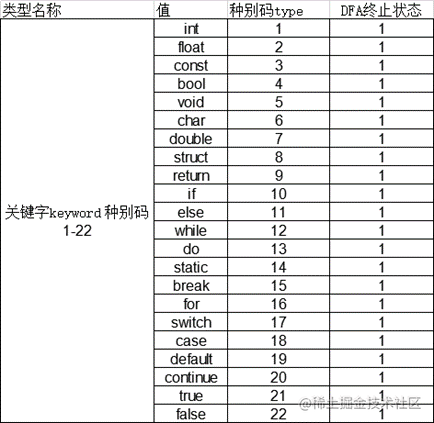
Keyword definition: keyword -> int float const bool void char double struct return if else while do static break for switch case default continue true false
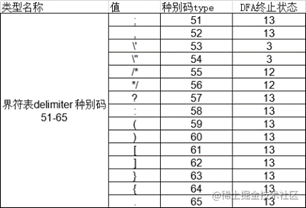
Delimiter definition: delimiter -> ; , ' " * */ ? : ( ) [ ] } { .
Integer definition: int -> (+|-)(0 | digit1 digit*)
Character constant: char -> letter|digit|...
String constant: string -> char*
Real number definition: double-> (0|(+|-)digit1 digit*)(.digit*)
My DFA diagram:
2. Data Structures Used
Output Token stream consists of type name + category code + value (keyword/variable name/number/operator/delimiter), with overloaded output stream.
struct Token {
    int type;   // 种别码
    string value;       // 值 关键字/变量名/数字/运算符/界符
    string category;    // 种别码对应的类型名称
    Token(int type, string value, string category) : type(type), value(value), category(category) {}
    friend ostream& operator<<(ostream& os, const Token& t) {
        os << t.category << ", type: " << t.type << ", value: " << t.value;
        return os;
    }
};

3. Header File Declarations and Global Variable Definitions
As follows, it should be quite self-explanatory.
#include <iostream>
#include <vector>
#include <string>
#include <fstream>
#include <map>
using namespace std;
const string CategoryFileName = "./categoryCode.txt";
const string CodeFileName = "./code.txt";
string keywords[22];  // 关键字表 种别码1-22
string operate[28];  // 运算符表 种别码23-50
string delimiter[15];  // 界符表 种别码51-65
map<string, int> categoryCode;  // 种别码表
const string op = "+-*/%=!&|<>";
const int _EOF_ = -2;
const int _ERROR_ = -1;
enum {
    _ID_, _INT_, _DOUBLE_, _OPERATOR_, _DELIMITER_, _KEYWORD_, _CHAR_, _STRING_, _COMMENT_, _SPACE_
};  // 类型
string cat[10] = { "id", "int", "double", "operator", "delimiter", "keyword", "char", "string", "comment", "space" };
struct Token {
    int type;   // 种别码
    string value;       // 值 关键字/变量名/数字/运算符/界符
    string category;    // 种别码对应的类型名称
    Token(int type, string value, string category) : type(type), value(value), category(category) {}
    friend ostream& operator<<(ostream& os, const Token& t) {
        os << t.category << ", type: " << t.type << ", value: " << t.value;
        return os;
    }
};
int pos, len;  // 当前字符位置和长度
string code, tempToken;  // 当前识别的字符串
vector<Token> tokenList;  // 存储识别出的token
4. Function Summary
(1) Function Summary Table
| Function Name | Brief Description |
|---|---|
readFile | File reading function, returns a dynamic string array |
init | Initialization function, reads category code file and keyword file, performs corresponding assignments and initialization |
peek | Peeks at the next character, returns it if it exists, otherwise returns \0 (string terminator) |
isDigit | Checks if character ch is a digit 0-9 |
isLetter | Checks if character ch is a letter or underscore (A-Z a-z _) |
isKeyword | Checks if string s is a keyword (in the keyword table) |
isOP | Checks if character ch is a single operator (in op) |
isOperator | Checks if string s is an operator (in the operator table) |
isDelimiter | Checks if character ch is a delimiter (in the delimiter table) |
judge | Core function, determines and returns the enum type of the current character (code[pos]), and handles some special tokens by directly placing them into tokenList (such as comments, character and string constants) |
read_next | Core function, reads the next character and places the corresponding token into tokenList based on the returned enum type |
main | Main program entry point, calls init function for initialization |
(2) Function Call Relationships
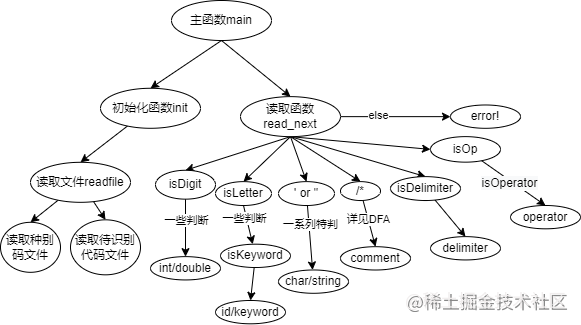
5. Experiment Results
Input
code.txt
int main() {
    char ch = 'ss';
    string str = "Hello, World!"
    char ch2 = 's';
    init();
    double x = 10.31;/* some comment */
    int m = 0;
    int y = 310, m = 0.31;
    while(pos < len) {
        int flag = read_next();
        if(flag == _EOF_) break;
        if(flag != _ERROR_) {
            Token t(flag, tempToken);
            tokenList.push_back(t);
            cout << t << endl;
        } else cout << "Error!" << endl;
    }
    return 0;
}
Output
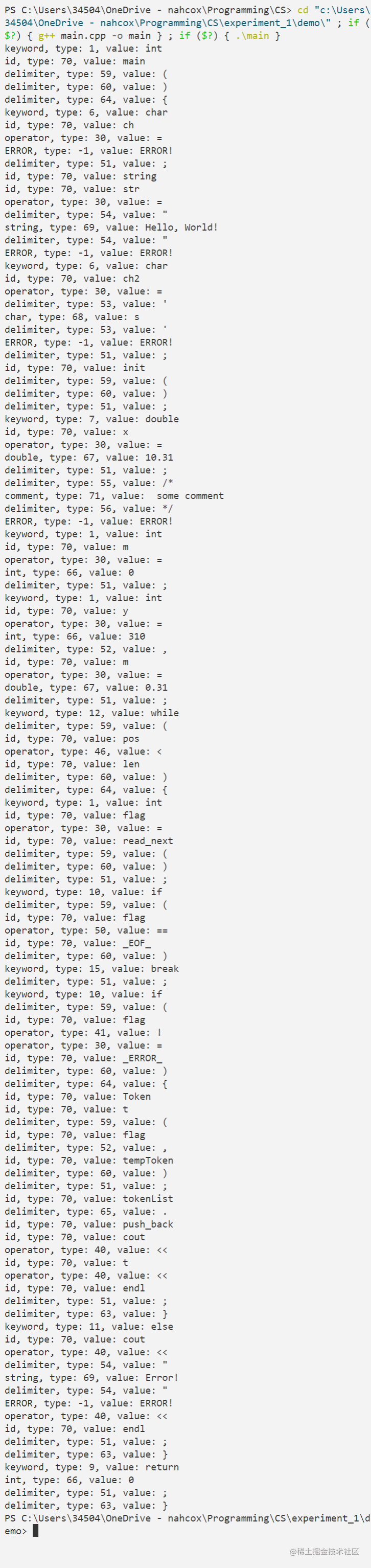
IV. Experiment Summary
This experiment was quite interesting, and it was very satisfying when everything finally worked. Personally, I think there’s no need to be fixated on which algorithm to use — just clarify your own thought process: how to design the program to correctly identify tokens? The main idea is based on priority: spaces and newlines are skipped first, then we check whether the character is a digit or letter and handle accordingly, followed by checking for special delimiters like strings, comments, etc. I believe the code itself explains the process well. This program currently only supports decimal numbers using the common period (.) symbol. If more are needed, modifications can be made in the judge function after isdigit(), which is not difficult. Obviously, the functions within judge could be broken down into more granular functions, but that can be done later.
V. Discussion Questions
What aspects of program design affect lexical analysis efficiency? How to improve efficiency?
Answer: There are still quite a few areas for optimization. For example, when determining whether something is a keyword, the current method reads the complete string that might be an identifier or keyword into a character array and then matches it against the keyword table one by one. This could be improved by checking during the reading process, which would improve efficiency. The same applies to delimiter matching.
Complete Code
/*
 * @Author: cos
 * @Date: 2022-04-05 00:10:59
 * @LastEditTime: 2022-04-08 02:37:49
 * @LastEditors: cos
 * @Description: 词法分析器设计实现
 * @FilePath: \CS\experiment_1\demo\main.cpp
 */
#include <iostream>
#include <vector>
#include <string>
#include <fstream>
#include <map>
using namespace std;
const string CategoryFileName = "./categoryCode.txt";
const string CodeFileName = "./code.txt";
string keywords[22];  // 关键字表 种别码1-22
string operate[28];  // 运算符表 种别码23-50
string delimiter[15];  // 界符表 种别码51-65
map<string, int> categoryCode;  // 种别码表
const string op = "+-*/%=!&|<>";
const int _EOF_ = -2;
const int _ERROR_ = -1;
enum {
    _ID_, _INT_, _DOUBLE_, _OPERATOR_, _DELIMITER_, _KEYWORD_, _CHAR_, _STRING_, _COMMENT_, _SPACE_
};  // 类型
string cat[10] = { "id", "int", "double", "operator", "delimiter", "keyword", "char", "string", "comment", "space" };
struct Token {
    int type;   // 种别码
    string value;       // 值 关键字/变量名/数字/运算符/界符
    string category;    // 种别码对应的类型名称
    Token(int type, string value, string category) : type(type), value(value), category(category) {}
    friend ostream& operator<<(ostream& os, const Token& t) {
        os << t.category << ", type: " << t.type << ", value: " << t.value;
        return os;
    }
};
int pos, len;  // 当前字符位置和长度
string code, tempToken;  // 当前识别的字符串
vector<Token> tokenList;  // 存储识别出的token
// 读文件
vector<string> readFile(string fileName) {
    vector<string> res;
    try {
        ifstream fin;
        fin.open(fileName);
        string temp;
        while (getline(fin, temp))
            res.push_back(temp);
        return res;
    } catch(const exception& e) {
        cerr << e.what() << '\n';
        return res;
    }
}
void init() {
    vector<string> res = readFile(CategoryFileName);
    // cout << "len:" << len << endl;
    for(int i = 0; i < 22; ++i) {
        keywords[i] = res[i];
        categoryCode[res[i]] = i+1;
        // cout << "keyword:" << res[i] << endl;
    }
    for(int i = 0; i < 28; ++i) {
        operate[i] = res[i + 22];
        categoryCode[res[i+22]] = i+23;
        // cout << "operate:" << res[i + 22] << endl;
    }
    for(int i = 0; i < 15; ++i) {
        delimiter[i] = res[i + 50];
        categoryCode[res[i+50]] = i+51;
        // cout << "delimiter:" << res[i + 50] << endl;
    }
    res = readFile(CodeFileName);
    for(int i = 0; i < res.size(); ++i)
        code += res[i]+'\n';
    len = code.size();
}
char peek() {
    if (pos+1 < len) return code[pos+1];
    else return '\0';
}
inline bool isDigit(char c) {
    return c >= '0' && c <= '9';
}
// 是否为字母或下划线
inline bool isLetter(char c) {
    return (c >= 'a' && c <= 'z') || (c >= 'A' && c <= 'Z') || c == '_';
}
bool isKeyword(string s) {
    for(int i = 0; i < 22; ++i)
        if (s == keywords[i])
            return true;
    return false;
}
bool isOP(char ch) {
    return op.find(ch) != string::npos;
}
bool isOperator(string s) {
    for(int i = 0; i < 28; ++i)
        if (s == operate[i]) return true;
    return false;
}
bool isDelimiter(char ch) {
    for(int i = 0; i < 15; ++i)
        if (ch == delimiter[i][0]) return true;
    return false;
}
int judge(char ch) {
    if(ch == '\n' || ch == ' ') return _SPACE_;
    if(isDigit(ch)) {
        char nextChar = peek();
        if(ch == '0' && nextChar == '.') { // 0.多少
            ++pos;
            if(!isDigit(peek()))   // .后面不是数字
                return _ERROR_;
            tempToken = "0.";
            while(isDigit(peek())) {
                tempToken += peek();
                ++pos;
            }
            return _DOUBLE_;    // 8
        } else if(ch == '0' && !isDigit(nextChar)) { // 不是数字也不是.,说明是单纯的一个0
            tempToken = "0";
            return _INT_;   // 5
        } else if(ch != '0') {  // digit1
            tempToken = ch;
            while(isDigit(peek())) {
                tempToken += peek();
                ++pos;
            }
            char nextChar = peek();
            if(nextChar == '.') {
                tempToken += nextChar;
                ++pos;
                nextChar = peek();
                if(isDigit(nextChar)) {
                    tempToken += peek();
                    ++pos;
                    while(isDigit(peek())) {
                        tempToken += peek();
                        ++pos;
                    }
                    return _DOUBLE_;    // 8
                } else return _ERROR_;
            } else return _INT_;    // 6
        } else {    // 0+数字
            ++pos;
            return _ERROR_;         // ERROR
        }
    }
    if(isLetter(ch)) {
        tempToken = ch;
        char nextChar = peek();
        while( isLetter(nextChar) || isDigit(nextChar) ) { // 标识符~
            tempToken += nextChar;
            ++pos;
            nextChar = peek();
        }
        return isKeyword(tempToken) ? _KEYWORD_ : _ID_;
    }
    if(ch == '\"') {
        tokenList.push_back(Token(54, "\"", cat[_DELIMITER_]));
        tempToken = "";
        char nextChar = peek();
        while(nextChar != '\"') {
            tempToken += nextChar;
            ++pos;
            nextChar = peek();
        }
        tokenList.push_back(Token(69, tempToken, cat[_STRING_]));
        tokenList.push_back(Token(54, "\"", cat[_DELIMITER_]));
        pos += 2;
        return _STRING_;
    }
    if(ch == '\'') {
        tempToken = "";
        ++pos;
        char nextChar = peek();
        if(nextChar == '\'') {
            tokenList.push_back(Token(53, "\'", cat[_DELIMITER_]));
            tempToken += code[pos];
            tokenList.push_back(Token(68, tempToken, cat[_CHAR_]));
            tokenList.push_back(Token(53, "\'", cat[_DELIMITER_]));
            ++pos;
            return _CHAR_;
        } else if(code[pos] == '\'') {
            tokenList.push_back(Token(53, "\'", cat[_DELIMITER_]));
            tokenList.push_back(Token(68, tempToken, cat[_CHAR_]));  // 空字符串
            tokenList.push_back(Token(53, "\'", cat[_DELIMITER_]));
            return _CHAR_;
        } else {
            while(pos < len && nextChar != '\'') {
                ++pos;
                nextChar = peek();
            }
            ++pos;
            return _ERROR_;
        }
    }
    if(ch == '/') {
        if(peek() == '*') {
            ++pos;
            char nextChar = peek();
            ++pos;
            tempToken = "";
            while(pos < len) {
                if(nextChar == '*' && peek() == '/') {
                    tokenList.push_back(Token(55, "/*", cat[_DELIMITER_]));
                    tokenList.push_back(Token(71, tempToken, cat[_COMMENT_]));
                    tokenList.push_back(Token(56, "*/", cat[_DELIMITER_]));
                    ++pos;
                    ++pos;
                    return _COMMENT_;
                } else {
                    tempToken += nextChar;
                    nextChar = peek();
                    ++pos;
                }
            }
            return _ERROR_;
        }
    }

    if(isOP(ch)) {   // op运算符
        tempToken = "";
        tempToken += ch;
        char nextChar = peek();
        if(isOP(nextChar)) {
            if(isOperator(tempToken + nextChar)) {
                tempToken += nextChar;
                ++pos;
                return _OPERATOR_;      // 15
            } else return _OPERATOR_;   // 14
        } else return _OPERATOR_;       // 14
    }
    if(isDelimiter(ch)) {
        tempToken = "";
        tempToken += ch;
        return _DELIMITER_;
    }
    return _ERROR_;
}
int read_next() {
    int type = judge(code[pos]);
    while(pos < len && type == _SPACE_) {
        ++pos;
        type = judge(code[pos]);
    }
    if(pos >= len) return _EOF_;
    ++pos;
    if(type == _ERROR_) return _ERROR_;
    if(type == _DOUBLE_) {
        // cout << "double: " << tempToken << endl;
        tokenList.push_back(Token(67, tempToken, cat[_DOUBLE_]));
        return _DOUBLE_;
    }
    if(type == _INT_) {
        // cout << "int: " << tempToken << endl;
        tokenList.push_back(Token(66, tempToken, cat[_INT_]));
        return _INT_;
    }
    if(type == _ID_) {  // 标识符
        // cout << "id: " << tempToken << endl;
        tokenList.push_back(Token(70, tempToken, cat[_ID_]));
        return _ID_;
    }
    if(type == _OPERATOR_ || type == _KEYWORD_ || type == _DELIMITER_) {
        tokenList.push_back(Token(categoryCode[tempToken], tempToken, cat[type]));
        return type;
    }
    return _ERROR_;
}
int main() {
    init();
    while(pos < len) {
        int flag = read_next();
        if(flag == _EOF_) break;
        else if(flag == _ERROR_) tokenList.push_back(Token(_ERROR_, "ERROR!", "ERROR"));
    }
    for(auto t : tokenList)
        cout << t << endl;
    return 0;
}
喜欢的话,留下你的评论吧~