This article has been machine-translated from Chinese. The translation may contain inaccuracies or awkward phrasing. If in doubt, please refer to the original Chinese version.
I. Topological Sort
1. Concept Definition
AOV Network
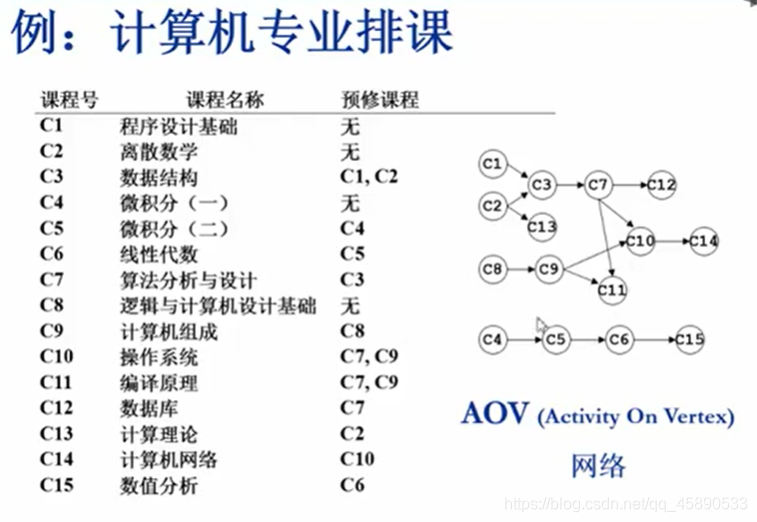
For example, suppose a computer science student must complete all the courses listed in Figure 3-4. The figure clearly shows the prerequisite and subsequent relationships among the courses. For instance, course C5 has C2 as its prerequisite and C4 and C6 as its subsequent courses. Typically, a directed graph where vertices represent activities and edges represent precedence relationships among activities is called an Activity On Vertex network (AOV network).
Topological Order, DAG
If there is a directed path from V to W in the graph, then V must be ordered before W. A vertex sequence satisfying this condition is called a topological order.
The process of obtaining a topological order is called topological sorting.
If an AOV has a valid topological order, it must be a Directed Acyclic Graph (DAG).
2. Topological Sort Approach
The idea of topological sort is to repeatedly find a vertex with in-degree 0, output it, and decrement the in-degrees of all its adjacent vertices by 1.
As we can see, finding vertices with in-degree 0 is the key. If we have to traverse every time, it would consume a lot of time and space. A smarter approach is to immediately place vertices whose in-degree becomes 0 into a container.
Pseudocode:
void TopSort() { int cnt = 0; for(each vertex V in the graph) if( Indegree[W] == 0) Enqueue(V,Q); while(!isEmpty(Q)) { V = Dequeue(Q); Output V, or record V's output sequence number, cnt++; for(each adjacent vertex W of V) if(--Indegree[W] == 0) Enqueue(V,Q); } if(cnt != |V|) Error("The graph has a cycle");}
Template code:
const int maxn = 1005;int N,M;//Number of vertices, number of edges (activities)int edge[maxn][maxn];int mint[maxn];//Earliest completion time for each activity checkpointint In[maxn];//In-degree of each activity checkpointvoid init() { memset(edge, -1, sizeof(edge)); memset(mint, 0, sizeof(mint)); memset(In, 0, sizeof(In));}bool Topsort() {//Topological sort queue<int> q; for(int i = 0; i < N; ++i) { if(In[i] == 0) q.push(i); } int cnt = 0; while(!q.empty()) { int v = q.front(); q.pop(); cnt++; for(int i = 0; i < N; ++i) { if(v == i || edge[v][i] == -1) continue;//Check all edges starting from v In[i]--; //Other operations if(In[i] == 0) q.push(i); } } if(cnt != N) return false; else return true;}
Example Problem
08-Graph 8 How Long Does It Take (25 points)
This is a variation of topological sort. The program is not overly complex; give it a try!
For problem description, code, and solution approach, see the referenced blog post.
3. Solving Practical Problems
Critical Path Problem
AOE (Activity On Edge) Network
Generally used for scheduling project tasks
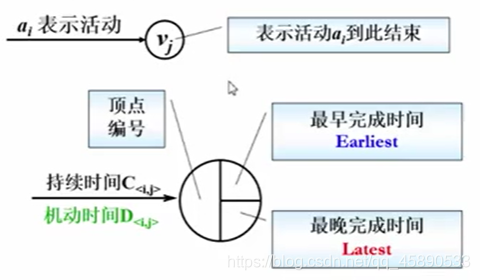
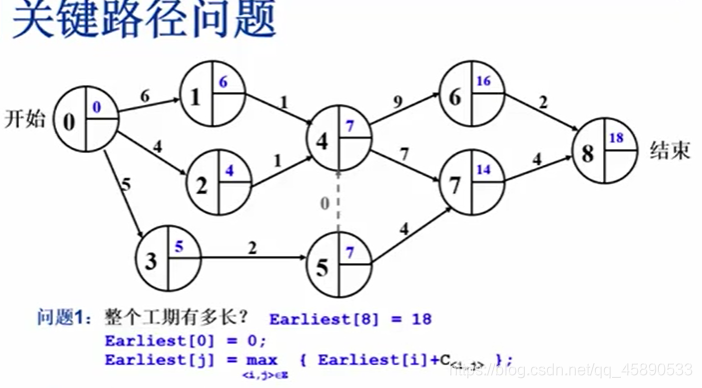
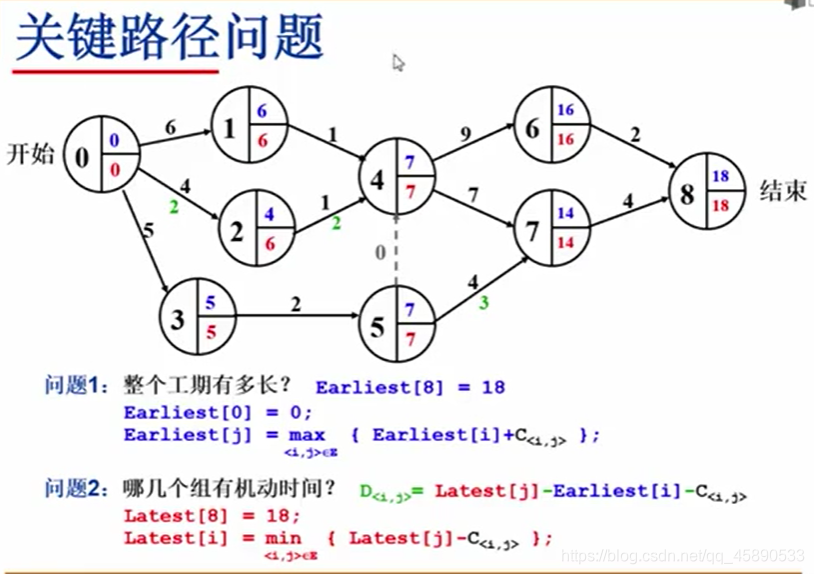
In an AOE network, activities are represented on edges, and vertices are divided into three parts: vertex number, earliest completion time, and latest completion time
First derive the earliest completion time -- mint [ j ] = max( mint[ j ], mint[ i ]+edge[ i ][ j ])
Then derive the latest completion time backwards -- maxt[ i ] = min( maxt[ j ], maxt[ j ]-edge[ i ][ j ])
This gives the slack time -- D[ i ][ j ] = maxt[ j ] - mint[ i ] - edge[ i ][ j ]
The critical path consists of activities that absolutely cannot be delayed, i.e., the path with no slack time.
It repeatedly steps through the list of elements to be sorted, compares two adjacent elements, and swaps them if they are in the wrong order (e.g., from large to small, or alphabetically from Z to A). The pass through the list is repeated until no adjacent elements need to be swapped, meaning the list is sorted.
The name of this algorithm comes from the fact that smaller elements "bubble" to the top of the list (in ascending or descending order), just like carbon dioxide bubbles eventually rise to the top of a carbonated drink, hence the name "Bubble Sort."
-- Excerpted from Baidu Encyclopedia
void Bubble_Sort(ll a[], int N) { for(int P = N-1; P >= 0; P--) { bool flag = false; //One pass of bubble: compare from top to bottom, swap if upper > lower for(int i = 0; i < P; ++i) { if(a[i] > a[i+1]) { swap(a[i], a[i+1]); flag = true; } } if(!flag) break; //Already sorted after one pass, no swaps occurred }}
Time Complexity
Best case: Already sorted, time complexity T = O(N)
Worst case: Completely reversed, time complexity T = O(N2)
Pros and Cons
Pros: Simple to write, only swaps adjacent elements, can directly sort even singly linked lists, stable (the relative positions of equal elements remain unchanged after swapping)
Cons: High time complexity, slow!
Test Results
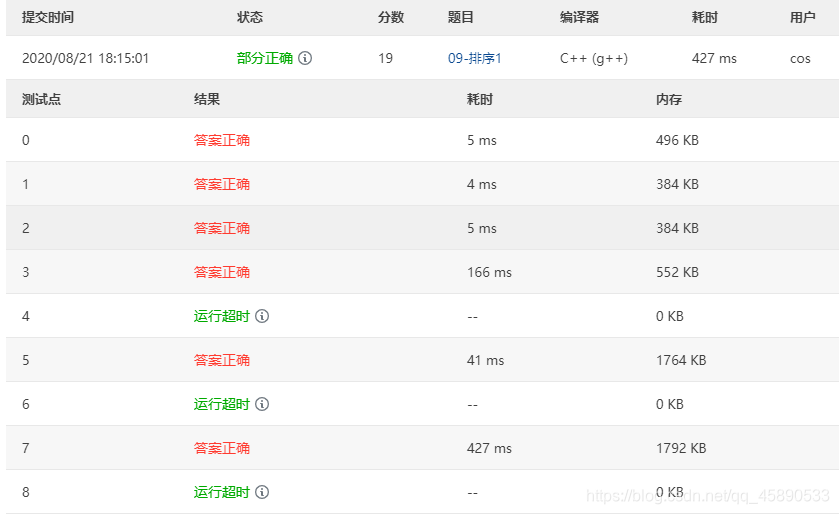
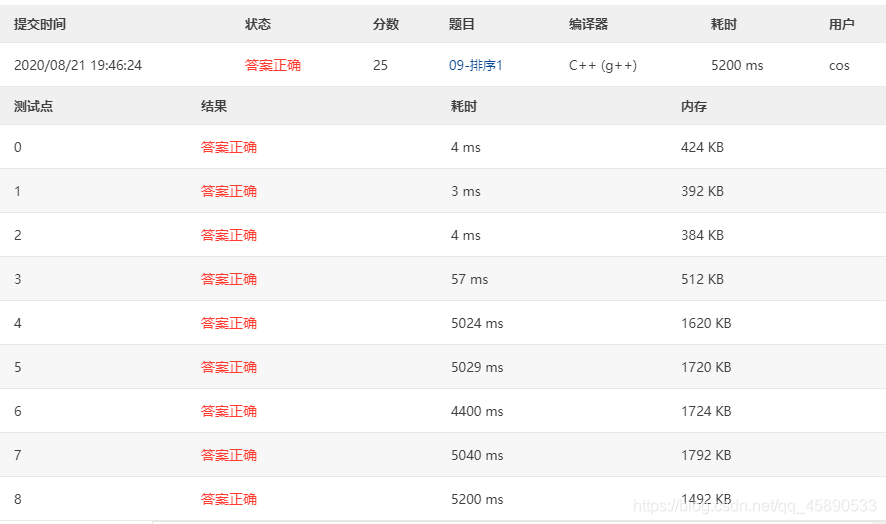
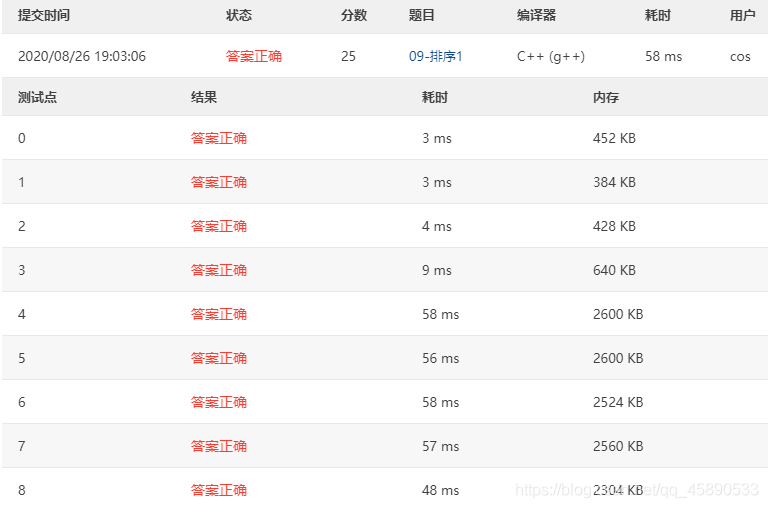
Test results shown below, 3 test cases failed:
Insertion Sort
Insertion sort, also commonly known as direct insertion sort, is an efficient algorithm for sorting a small number of elements. It is one of the simplest sorting methods. The basic idea is to insert a record into an already sorted list, resulting in a new sorted list with one more record. The implementation uses a double loop: the outer loop iterates over all elements except the first, and the inner loop searches for the insertion position within the already sorted portion and performs shifting.
-- Excerpted from Baidu Encyclopedia
void Insertion_Sort(ll a[], int N) { for(int P = 1; P < N; P++) { ll t = a[P];//Pick up the next card int i; for(i = P; i > 0 && a[i-1] > t; --i) a[i] = a[i-1]; //Make room until the preceding element is less than the current element a[i] = t; //Place the new card }}
Time Complexity
Best case: Already sorted, time complexity T = O(N)
Worst case: Completely reversed, time complexity T = O(N2)
General case time complexity lower bound calculation:
Swapping two adjacent elements eliminates exactly 1 inversion pair.
Let there be I inversion pairs.
Then T(N, I) = O(N + I)
Pros and Cons
Pros: Stable
Cons: The number of comparisons varies; fewer comparisons lead to more data movement after the insertion point, especially when the data volume is large.
Test Results
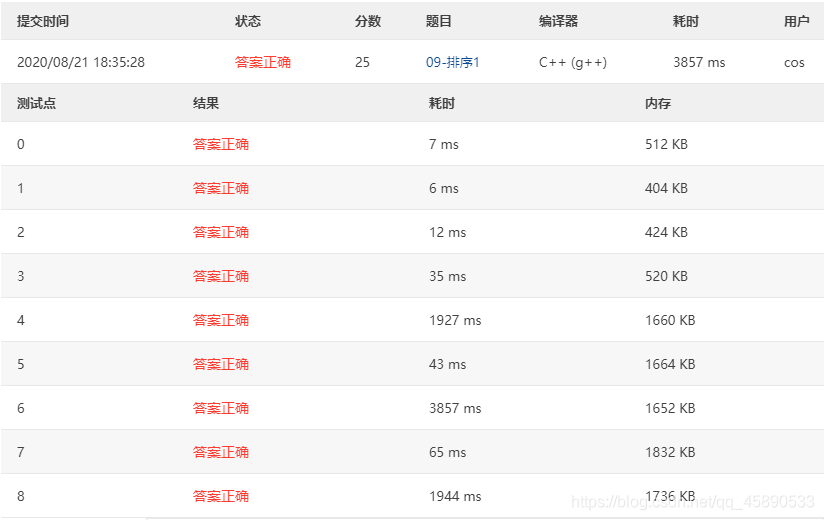
Test results shown below, quite impressive:
How to Improve Efficiency
The following theorems hold:
Any sequence of N distinct elements has an average of N(N-1)/4 inversion pairs
Any sorting algorithm that only swaps adjacent elements has an average time complexity of O(N2)
Therefore, to improve algorithm efficiency, we must:
Eliminate more than 1 inversion pair at a time!
Swap elements that are far apart each time!
Shell Sort
Takes advantage of insertion sort's simplicity while overcoming the limitation that insertion sort can only swap adjacent elements.
Shell sort groups records by a certain increment of their indices, uses direct insertion sort on each group; as the increment gradually decreases, each group contains more and more elements. When the increment reaches 1, the entire array becomes one group, and the algorithm terminates.
-- Excerpted from Baidu Encyclopedia
Define an increment sequence DM > DM-1 > ... > D1 = 1
For each Dk, perform "Dk-interval" sorting (k = M, M-1, ..., 1)
Note: A sequence that is "Dk-interval" sorted will remain "Dk-interval" sorted after performing "Dk-1-interval" sorting!
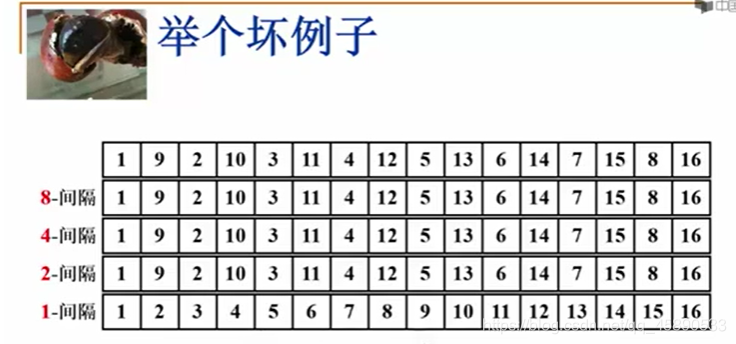
If increment elements are not coprime, smaller increments may have no effect!
void Shell_Sort(ll a[], int N) { for(int D = N/2; D > 0; D /= 2) { //Shell increment sequence for(int P = D; P < N; ++P) { //Insertion sort ll t = a[P]; int i; for(i = P; i >= D && a[i-D] > t; i -= D) a[i] = a[i-D]; a[i] = t; } }}
Hibbard increment sequence
Dk = 2k - 1 -- adjacent elements are coprime
Sedgewick increment sequence, etc.
Pros and Cons
Pros: Fast, with less data movement! Suitable for large data volumes.
Cons: Different increment sequence selections lead to varying algorithm complexities; how to choose the increment sequence can only be based on experience; unstable.
Test Results
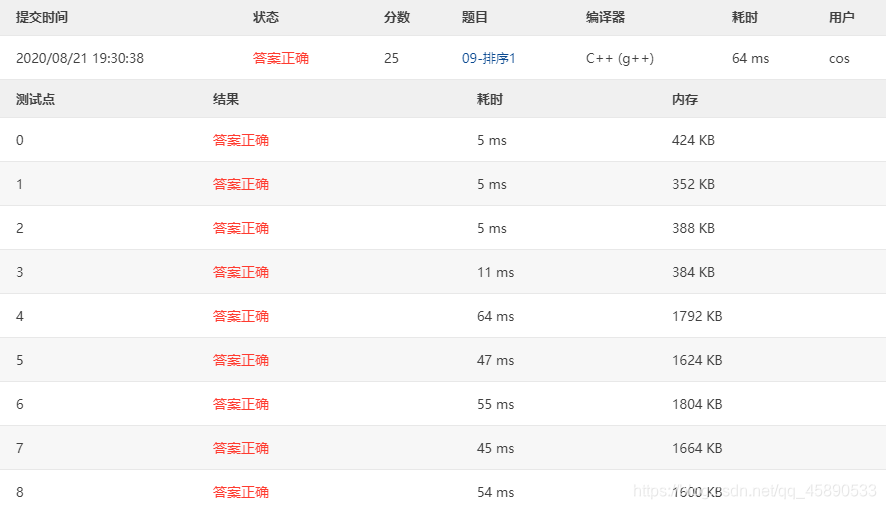
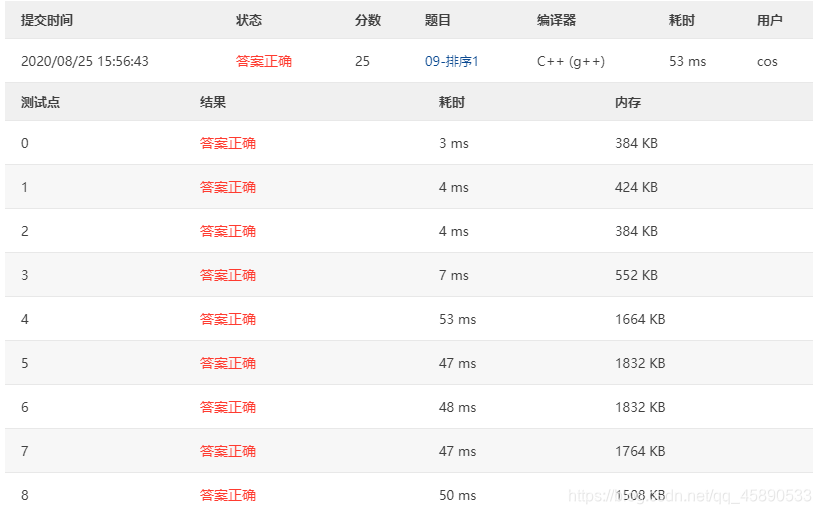
As you can see, execution time never exceeded 100ms. The speed for these test cases is very satisfactory:
Selection Sort
Before introducing heap sort, let's introduce selection sort, an old friend.
void Selection_Sort(ll a[], int N) { for(int i = 0; i < N; ++i) { int mini = 0; ll ans = inf; //Find the minimum element after position i and assign its position to mini for(int j = i; j <= N-1; ++j) { if(a[j] < ans) { ans = a[j]; mini = j; } } //Swap the minimum of the unsorted portion to the end of the sorted portion swap(a[i], a[mini]); }}
Time Complexity
The complexity is O(N2) regardless of the input.
Test Results
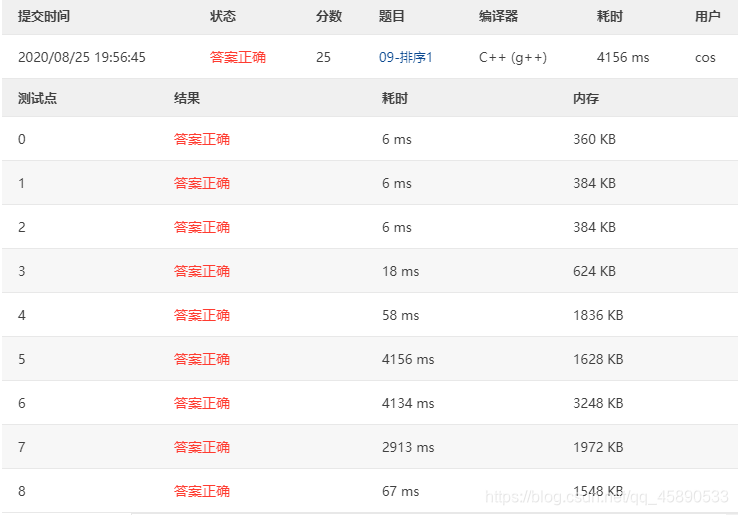
Test results shown below. Although all test cases pass, the last few cases take a long time:
Heap Sort
Here we use ascending order as an example. We need to adjust the original array into a max-heap starting from index 0, then swap the max-heap's top with the current last element (equivalent to deleting the max-heap's top) and readjust.
void swap(ll& x, ll& y) { ll t = x; x = y; y = t;}void PercDown(ll a[], int N, int rt) { //Adjust the subtree rooted at a[now] in an array of N elements into a max-heap int father, son; ll tmp = a[rt]; for(father = rt; (father*2+1) < N; father = son) { son = father * 2 + 1;//Left child if(son != N-1 && a[son] < a[son+1]) //Right child exists and is larger than left child son++; if(tmp >= a[son]) break;//Found the right place else a[father] = a[son];//Percolate down } a[father] = tmp;}inline void BuildHeap(ll a[], int N) { for(int i = N/2-1; i >= 0; --i) { PercDown(a, N, i); }}void Heap_Sort(ll a[], int N) { BuildHeap(a, N); for(int i = N-1; i > 0; --i) { swap(a[0], a[i]);//Swap max-heap top a[0] with a[i] PercDown(a, i, 0);//Readjust after deletion }}
Time Complexity
Heap sort provides the best average time complexity:
Best case O(nlogn)
Worst case O(nlogn)
Average time complexity O(nlogn)
Pros and Cons
Pros: Fast! Even in the worst case, performance is excellent, and it uses little auxiliary space.
Cons: Unstable, not suitable for sorting objects.
Test Results
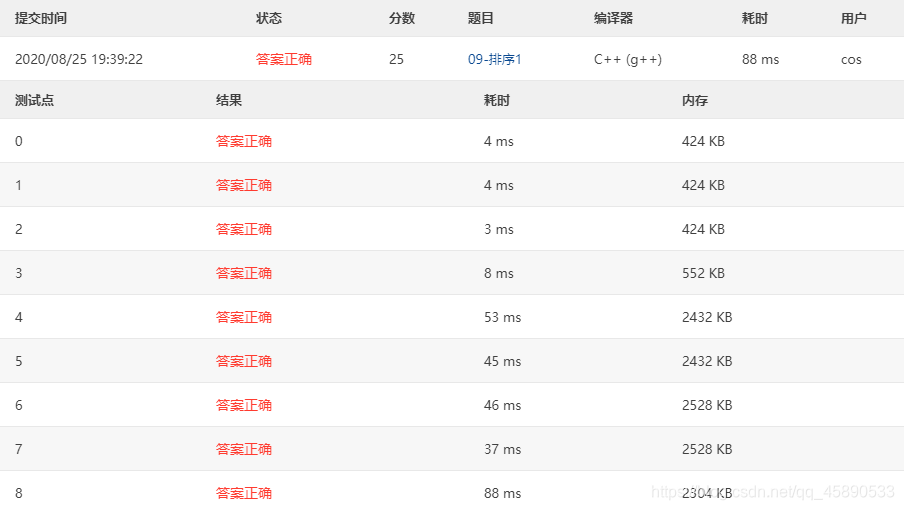
Test results shown below, seems even better than Shell sort:
Merge Sort
The core is merging sorted subsequences. Here is the recursive implementation. For the non-recursive implementation, see Merge Sort Iterative Implementation
void Merge(ll a[], int s, int m, int e, ll tmp[]) { //Merge the local portions a[s,m] and a[m+1,e] of array a into array tmp, keeping tmp sorted //Then copy back to a[s,m] Time complexity O(e-m+1), i.e., O(n); int pb = s;//pb is the index for tmp array int p1 = s, p2 = m+1;//p1 points to the first half, p2 points to the second half while (p1 <= m && p2 <= e) { if (a[p1] < a[p2]) tmp[pb++] = a[p1++]; else tmp[pb++] = a[p2++]; } while(p1 <= m) tmp[pb++] = a[p1++]; while(p2 <= e) tmp[pb++] = a[p2++]; for (int i = 0; i < e-s+1; ++i) a[s+i] = tmp[i];}void MergeSort(ll a[], int s, int e, ll tmp[]) { if (s < e) {//Do nothing if s >= e int m = s + (e-s)/2; MergeSort(a, s, m, tmp);//Sort the first half MergeSort(a, m+1, e, tmp);//Sort the second half Merge(a, s, m, e, tmp);//Merge: merge the sorted subarrays a[s..m] and a[m+1..e] }}
Time Complexity
Best case O(nlogn)
Worst case O(nlogn)
Average time complexity O(nlogn)
Pros and Cons
Pros: Stable, fast
Cons: Requires more space
Test Results
Test results shown below, take a close look:
Quick Sort
Set k = a[0], move k to the appropriate position so that all elements smaller than k are on its left and all elements larger than k are on its right (done in O(n) time). 2. Quick sort the left part of k. 3. Quick sort the right part of k.
k is the pivot.
void QuickSort(ll a[], int s, int e){//Quick sort a[s,e] if (s >= e) return; int k = a[s]; int i = s,j = e; while (i != j) { while (j > i && a[j] >= k) --j; swap(a[i],a[j]); while (i < j && a[i] <= k) ++i; swap(a[i],a[j]); }//After processing, a[i] = k; QuickSort(a, s, i-1);//Quick sort the left part QuickSort(a, i+1, e);//Quick sort the right part}
Time Complexity
Best case: Perfect partition each time, O(nlogn)
Worst case: O(N2)
Average time complexity O(nlogn)
Pros and Cons
Pros: The fastest algorithm among all internal sorting algorithms.
Cons: Unstable, slow in the worst case!
Test Results
Test results shown below:
Table Sort
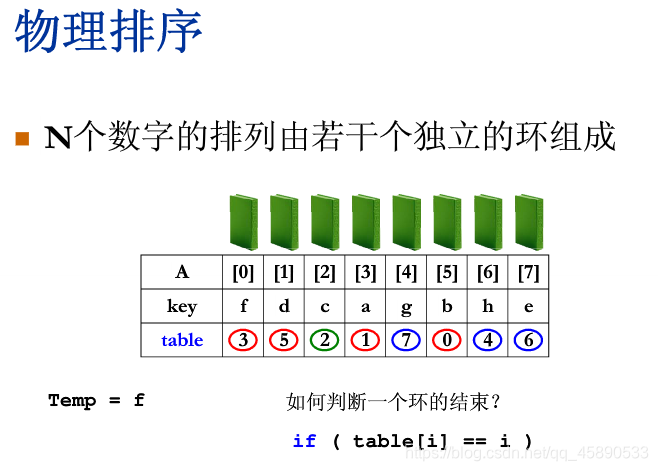
When the data volume is large and the elements to be sorted are objects whose movement requires significant time, we need indirect sorting.
Define a pointer array as a "table" to keep track of the elements to be sorted.
Time Complexity
Best case: Initially sorted.
Worst case: N/2 cycles, each containing 2 elements, swapping two elements takes three steps, requiring 3N/2 element moves.
T = O(m N), where m is the copy time for each element A.
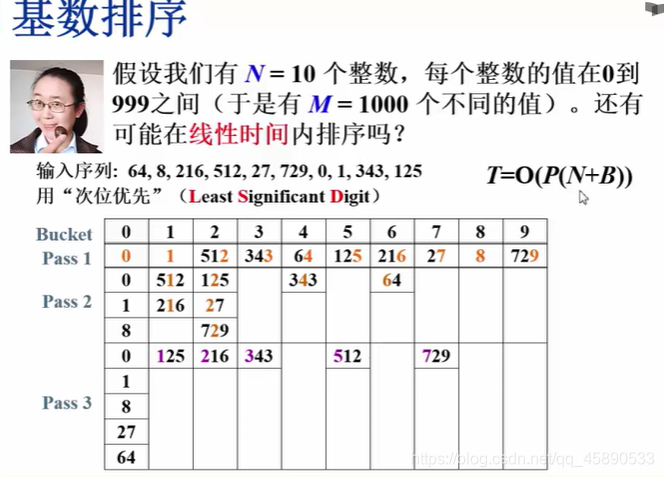
Radix Sort (Generalization of Bucket Sort)
The algorithms discussed earlier all require comparisons, and in the worst case they all have Nlogn complexity. Can we go faster?
Suppose we have N students with grades between 0 and 100 (so there are M = 101 distinct grade values). How can we sort students by grade in linear time?
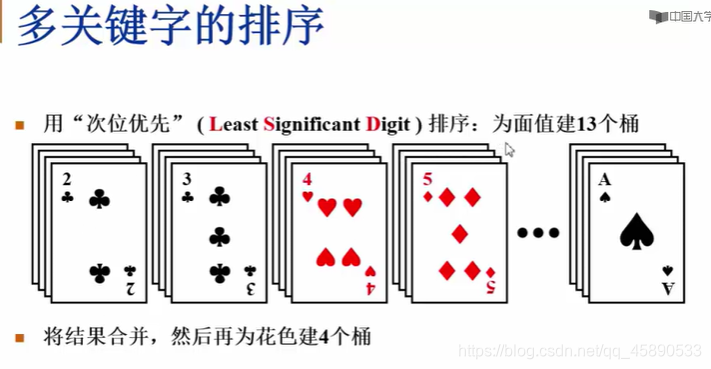
LSD (Least Significant Digit first) MSD (Most Significant Digit first)
>
I referenced this blog post for the radix sort code, which uses a very clever method: Radix Sort
ll getMax(ll a[], int n) {//Find the maximum in array a of n elements int maxx = a[0]; for(int i = 1; i < n; ++i) { if(a[i] > maxx) maxx = a[i]; } return maxx;}void radixsort(ll a[], int n, int exp) { //Sort array a of n elements by "a certain digit" (bucket sort), radix 10 ll tmp[maxn]; ll T[20] = {0}; //With negative numbers in decimal, 20 buckets for(int i = 0; i < n; ++i) //T stores how many numbers are in each bucket T[(a[i]/exp)%10 + 10]++; for(int i = 1; i < 20; ++i) //Make T values represent positions in tmp T[i] += T[i-1]; for(int i = n - 1; i >= 0; --i) { int now = T[(a[i]/exp)%10 + 10];//The position where this number should go tmp[now-1] = a[i]; T[(a[i]/exp)%10 + 10]--; } for(int i = 0; i < n; ++i) a[i] = tmp[i]; //Copy the sorted tmp back to a}void Radix_Sort(ll a[], int n) { ll maxnum = getMax(a, n); for(int exp = 1; maxnum/exp > 0; exp *= 10) radixsort(a, n, exp);}
Time Complexity
N is the number of elements to sort, and B is the number of buckets.
O(P(N+B)): One pass of distribution takes O(N), one pass of collection takes O(B), and P passes of distribution and collection are performed in total.
Pros and Cons
Pros: Suitable for cases where the number of digits is small and the maximum number of digits is not particularly large; fast.
Cons: Trades space for time.


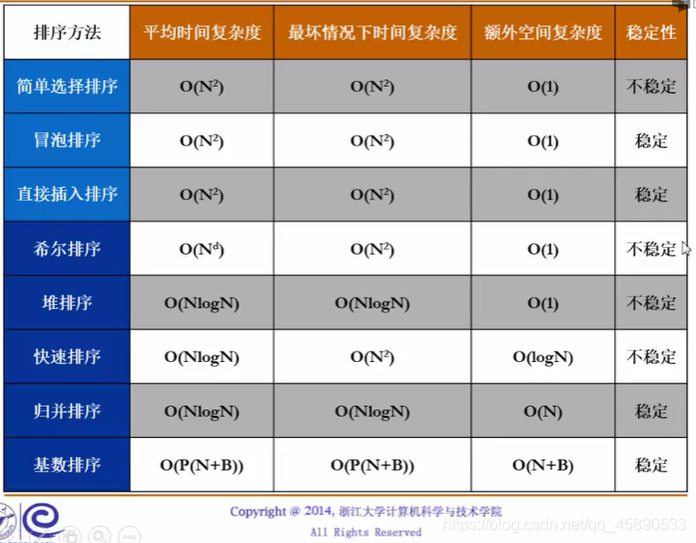
喜欢的话,留下你的评论吧~